בס "ד
EIN GEDANKE ÜBER PARSHAT VAERA 5786
Unter Schemot (Exodus), Hier finden wir eine tiefgründige Botschaft der Befreiung, die sowohl die Geschichte des jüdischen Volkes als auch den persönlichen spirituellen Weg jedes Einzelnen widerspiegelt. Als Mose sich an den Pharao wendet und fragt: “Lass mein Volk ziehen”, antwortet dieser: “Wer ist Haschem, dass ich das Volk ziehen lassen sollte?” Diese Begegnung bereitet den Boden für die zehn Plagen, deren letztendlicher Zweck darin besteht, ganz Ägypten die höchste Autorität Gottes zu offenbaren.
“וְיָדְעוּ מִצְרַיִם כִּי אֲנִי ה'’
“Und Ägypten soll erkennen, dass ich der HERR bin.” (2. Mose 7,5)
Die Netivot Shalom stellt eine wunderschöne Verbindung her zwischen der Arche Noah, den zehn Plagen und unserem persönlichen Weg zur spirituellen Erlösung.
Die Arche Noah: Drei Ebenen, drei Schichten der Befreiung
Das hebräische Wort für Arche, Teiváh (תֵּיבָה), hat mehrere Bedeutungsebenen:
Eine physische Arche oder Truhe, wie zum Beispiel die Arche Noah oder der Korb des Moses.
- Ein “Wort”, zusammengesetzt aus Buchstaben – in Anlehnung an die Teiváh der Tora und des Gebets, einen spirituellen Raum für Schutz und Führung.
Die Arche Noah hatte drei Ebenen, die jeweils einem bestimmten Zweck dienen:
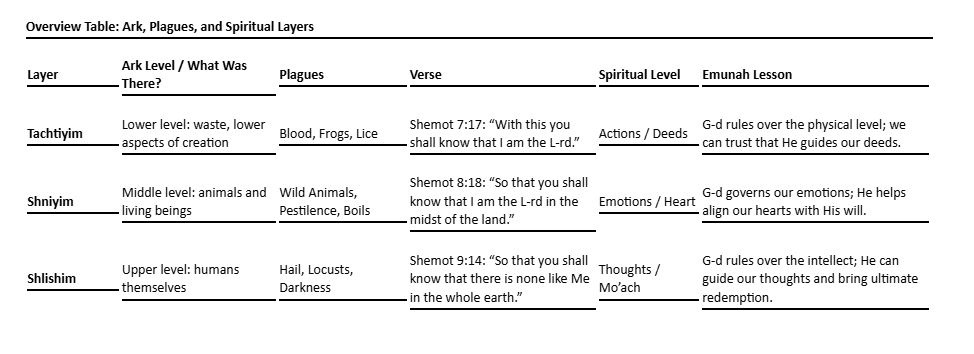
- Untere Ebene: reserviert für Abfall und die niederen Aspekte der Schöpfung → entspricht Handlungen und Taten.
- Mittleres Niveau: reserviert für Tiere und Lebewesen → entspricht Gefühle und Wünsche.
- Obere Ebene: reserviert für Menschen selbst → entspricht Gedanken und Intellekt.
Rashi, Chizkuni und Kli Yakar betonen, dass diese Ebenen beabsichtigt waren und verschiedene Realitätsebenen von der niedrigsten bis zur höchsten widerspiegeln.
Die Plagen: Ein Spiegel unserer drei Schichten und der Souveränität Gottes
Die zehn Plagen sind mehr als nur physische Katastrophen; sie vermitteln eine tiefgreifende Lektion über Gottes Herrschaft über die gesamte Schöpfung und dienen als Leitfaden für persönliches spirituelles Wachstum. Die Plagen entsprechen den drei Ebenen der Arche Noah, von denen jede mit einem Bibelvers verbunden ist, der Gottes Souveränität betont:
- Tachtiyim – Die unterste Schicht
- Seuchen: Blut, Frösche, Läuse
- Vers:
“בְּזֹאת תֵּדַע כִּי אֲנִי ה'’ (Shemot 7:17)
“Daran werdet ihr erkennen, dass ich der Herr bin.”
- Fokus: Auf die niedrigsten Aspekte der Schöpfung ausgerichtet: Wasser, Erde und Grund.
- Spirituelle Ebene: Spiegelt unser Handeln und unser tägliches Verhalten – die physische Ebene.
- Emunah: Gott herrscht über die physische Welt und stärkt so unser Vertrauen, dass er unsere Taten leitet und segnet.
- Shniyim – Die mittlere Schicht
- Seuchen: Wildtiere, Seuchen, Geschwüre
- Vers:
“לְמַעַן תֵּדַע כִּי אֲנִי ה' בְּקֶרֶב הָאָרֶץ’ (Shemot 8:18)
“Damit ihr erkennt, dass ich der Herr inmitten des Landes bin.”
- Fokus: Gerichtet gegen Lebewesen auf der Erdoberfläche.
- Spirituelle Ebene: Spiegelt Gefühle und Wünsche – das Herz, die mittlere Schicht eines Menschen.
- Emunah: Gott lenkt unsere Gefühle und Wünsche und hilft uns, unser Herz mit seinem Willen in Einklang zu bringen.
- Shlishim – Die höchste Schicht
- Seuchen: Hagel, Heuschrecken, Dunkelheit
- Vers:
“בַּעֲבוּר תֵּדַע כִּי אֵין כָּמֹנִי בְּכָל־הָאָרֶץ” (Shemot 9:14)
“Damit ihr erkennt, dass es keinen gibt, der mir gleich ist auf der ganzen Erde.”
- Fokus: Auf die Atmosphäre und den Himmel gerichtet.
- Spirituelle Ebene: Dieser Vers spiegelt die höchste Ebene der menschlichen Seele wider, die Folgendes umfasst: Gedanken und Intellektt – die mo'ach. Der mo'ach ist das physische Gehirn, das die intellektuelle Dimension des Gehirns kanalisiert und zum Ausdruck bringt. Neshama (Seele), die unser Denken und Verstehen mit spiritueller Einsicht verbindet.
- Emunah: Gott herrscht über den Intellekt und die komplexesten Aspekte der Existenz und versichert uns, dass er unsere Gedanken lenken und uns die endgültige Erlösung gewähren kann.
Anhand dieser drei Plagen erkennen wir, dass Gott über alle Ebenen der Existenz herrscht: die physische, die emotionale und die intellektuelle.
Die zehnte Plage: Gott selbst bringt die endgültige Erlösung
Die zehnte Plage, der Tod der Erstgeborenen, stellt einen tiefgreifenden Wendepunkt im Erlösungsprozess dar:
“וַיְהִי בַּחֲצִי הַלַּיְלָה וַיהוָה הִכָּה כָּל־בְּכוֹר בְּאֶרֶץ מִצְרַיִם…” (Shemot 12:29)
“Und es geschah um Mitternacht, dass der HERR alle Erstgeborenen im Land Ägypten schlug, vom Erstgeborenen des Pharao, der auf seinem Thron saß, bis zum Erstgeborenen des Gefangenen im Kerker und alle Erstgeborenen des Viehs.”
Anders als die vorherigen Plagen beginnt diese hier von oben, der Intellekt, und wirkt sich über Emotionen und Handlungen nach unten aus. Die Botschaft ist klar: Die endgültige Erlösung kommt allein von Gott selbst..
Die Weisen lehren, dass die Sünde in drei Schritten entsteht: Die Augen sehen, das Herz begehrt und der Körper handelt (Raschi, Numeri 15,39). Die Augen agieren im Bereich des Intellekts, verbunden mit den “Gefäßen” des Verstehens. In der zehnten Plage greift Gott auf höchster Ebene ein, um die vollständige Erlösung einzuleiten.
Obwohl wir uns bemühen können, unser Handeln, unsere Gefühle und Gedanken zu verfeinern, bleiben manche Aspekte außerhalb unserer Kontrolle. Geulah Die Erlösung kommt von Gott, indem er mit dem Verstand beginnt und durch seine Führung und Macht die Gefühle und Handlungen heiligt.
Die Teiváh: Schutz, Führung und spirituelles Wachstum
So wie Noah während der Sintflut Schutz in der Arche fand, können auch Menschen in ihrer Heimat Sicherheit und Orientierung finden. Teivot – ihre Worte der Tora und des Gebets. Die Teiváh bietet einen spirituellen Raum zur Erneuerung, Reinigung und zur richtigen Gestaltung des eigenen Lebens.
Für Noachiden, Dies beinhaltet das Studium der sieben Noachidische Gesetze, Diese dienen als übergeordnete Kategorien moralischer und spiritueller Orientierung. Aus diesen Kerngesetzen leiten sich viele ab. Abgeleitete Gesetze und praktische Anwendungen Daraus ergeben sich Erkenntnisse, die im Alltag umgesetzt werden müssen. Durch dieses Studium lernen die Noachiden, ihren Charakter zu verfeinern und ihr Handeln mit dem Willen Gottes in Einklang zu bringen.
Obwohl Noachiden nicht ausdrücklich wie Juden zum Gebet verpflichtet sind, benötigen Menschen kein Gebot zum Beten, denn das Gebet ist der natürliche und offensichtliche Ausdruck ihrer Verbindung zu G-tt. Der Glaube an G-tt inspiriert uns ganz natürlich dazu, seine Hilfe und Führung zu suchen. Das Gebet wird so zu einem Werkzeug für persönliches Wachstum im Einklang mit seinem Willen und für eine bessere Welt. Die Teivah – ein Ort des Studiums und des Gebets – dient als … persönliche Arche, und bietet Schutz, Führung und schrittweise spirituelle Entwicklung, genau wie Noah und seine Familie in der Arche beschützt und geführt wurden.
Fazit: Handlungen, Emotionen und Gedanken
Unsere spirituelle Reise spiegelt die Struktur der Arche und die Plagen wider:
- Aktionen: Reinigung unseres täglichen Verhaltens.
- Emotionen: Verfeinerung und Transformation von Wünschen und Gefühlen.
- Gedanken: die höchste Ebene, von Gott gelenkt, die alles beeinflusst, was darunter liegt.
Die zehn Plagen veranschaulichen, dass Erlösung ein Prozess ist, und Die endgültige Befreiung kommt von Gott selbst.. Die Anerkennung seiner Souveränität über alle drei Ebenen der Existenz ermöglicht es uns, die persönliche Erlösung und das spirituelle Wachstum mit Zuversicht anzugehen.
Die Teiváh – unsere Lade der Worte, des Gebets und der Tora – ist der Schlüssel zu Schutz, Führung und vollständige spirituelle Erlösung.
Übersichtstabelle: Arche, Plagen und spirituelle Schichten
Von Angelique Sijbolts
Vielen Dank an Rabbinerin Tani Burton für das Feedback.
Quellen
- Auszüge aus dem Nesivos Sholom von Rabbi S. Binyomin Ginsberg, S. 117-118
© Copyright, alle Rechte vorbehalten. Wenn Ihnen dieser Artikel gefallen hat, ermutigen wir Sie, ihn weiter zu verbreiten.
Unsere Blogs können Texte/Zitate/Referenzen/Links enthalten, die urheberrechtlich geschütztes Material von Mechon-Mamre.org, Aish.com, Sefaria.org, Chabad.orgund/oder FragNoah.orgdie wir in Übereinstimmung mit ihren Richtlinien verwenden.
 German
  English
  Dutch
Dutch  French
  Spanish
  Italian
  Hebrew
  Korean