בס "ד
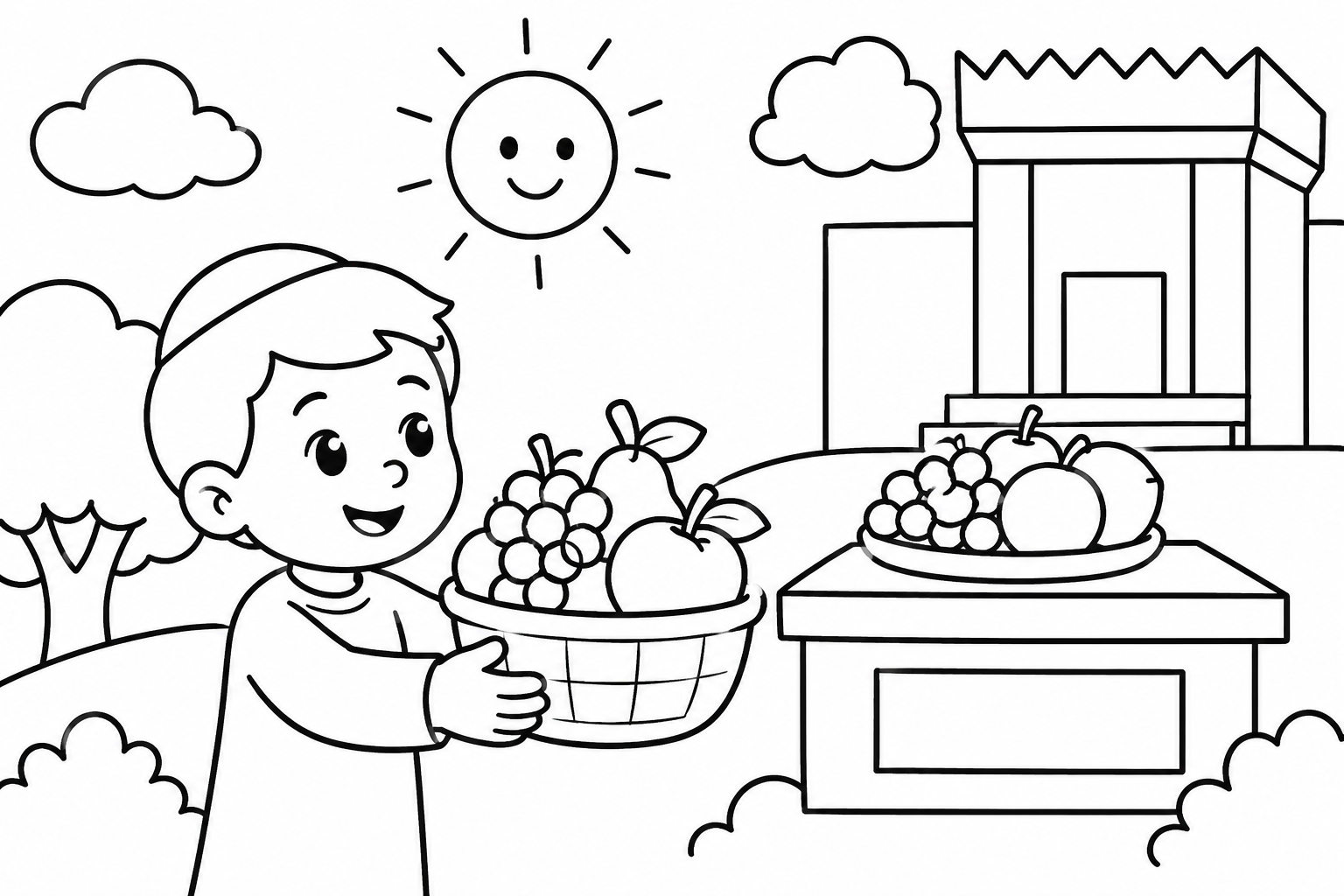
Imagine a farmer.
He has a beautiful tree.
The tree has many fruits.
Some fruits are very big and beautiful.
The farmer chooses the best fruits.
He says:
“These are for G-d.”
He brings them to the Temple.
He is happy.
He is thankful.
He knows:
“Everything I have comes from G-d.”
We can do this too.
When we wake up in the morning,
we can first thank G-d.
Podemos decir:
“Thank You, G-d, for my life.
Thank You for waking me up.
Thank You for my family.
Thank You for everything I have.”
Then we start our day.
We go to school.
We play.
We learn.
We help others.
And we do our best.
A practical example:
Imagine that Mom gives you a cookie.
You get one cookie.
Then you see that your brother also wants a cookie.
You could eat the whole cookie yourself.
But you think:
“I have something good.
I can share it.”
So you give some of your cookie to your brother.
Now you are happy.
And your brother is happy too.
This is one way to give your best.
We do not always have to keep the best things for ourselves.
We can be thankful.
We can share.
We can help others.
And we can be happy with what we have.
Because everything we have
is a gift from G-d.
The Lesson is: Give your best to G-d with joy and gratitude. Be thankful for what you have, share with others, and trust that true blessing comes from the Creator.
Por el rabino Moshe Bernstein y Angelique Sijbolts
Fuentes
Deuteronomy 26:10-11. Rashi, Deuteronomy 26:10. Sefer HaSichot 5748, Vol. 2, p. 636 – Explanation of the spiritual concept of the “first,” serving G-d with joy, and its radiation over the entire course of life.
Si quieres más preguntas para la contemplación, VER LOS OTROS BLOGS DEL RABINO MOSHE BERNSTEIN
Copyright, todos los derechos reservados. Si le ha gustado este artículo, le animamos a seguir difundiéndolo.
Nuestros blogs pueden contener textos/citas/referencias/enlaces que incluyan material protegido por derechos de autor de Mechon-Mamre.org, Aish.com, Sefaria.org, Jabad.orgy/o AskNoah.orgque utilizamos de acuerdo con sus políticas.