
בס "ד
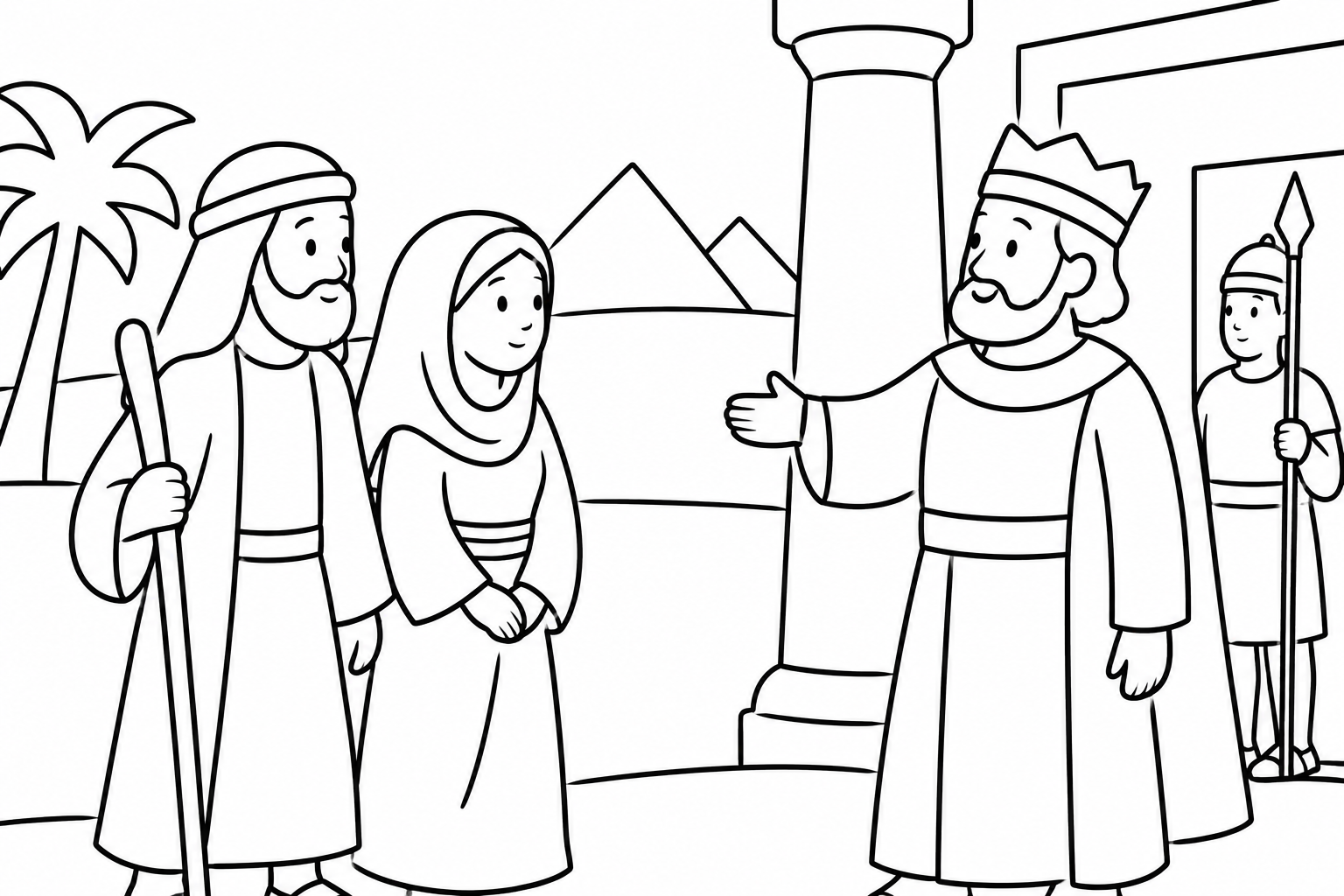
Abraham and Sarah had to travel to Egypt.
There was not enough food in their land.
Abraham was worried.
He knew that some people in Egypt did not always do the right thing. They sometimes thought only about themselves.
Abraham was afraid that someone might hurt him to take Sarah away.
So Abraham said to Sarah:
“Please tell the people that you are my sister. Then they may not know that I am your husband. Maybe this will help keep us safe.”
Abraham trusted Hashem. He knew that Hashem was watching over them. But Abraham also tried to be careful and protect himself.
The people in Egypt saw that Sarah was very beautiful.
The king heard about Sarah. He brought her to his palace.
But Hashem watched over Sarah. He showed the king that something was wrong.
The king understood that Sarah could not stay with him.
He let Sarah and Abraham go.
They were safe!
Abraham knew that Hashem had helped them. He also knew that people must try to do what is right.
Imagine you are at school.
There is a rule: Do not take things that belong to someone else.
One day, you see a toy on the floor. The teacher is not looking.
You think, “I could take it. Nobody will know!”
But then you remember Hashem.
You think, “Even when my teacher does not see me, Hashem sees me. I want to do what is right.”
So you give the toy back to its owner.
You feel good because you made the right choice.
Rules are important. But rules alone are not enough.
We must also learn to know the difference between right and wrong in our hearts.
The Lesson Is:
Do what is right, even when nobody is watching. Hashem always sees us. When we remember Hashem and follow His rules, we learn to be honest, kind, and fair. That is how we help make the world a better place.
Par le rabbin Moshe Bernstein et Angelique Sijbolts
Sources et références
Abraham and Sarah’s Descent into Egypt: Genesis 12:10–20. Likutei Sichos Vol. 20 page 38.
Sarah’s high holiness: Zohar Lech Lecha 77b-78a.
“Surely There Is No Fear of G-d”: Genesis 20:10–12.
Definition of Forbidden Relationships for Noahides: Babylonian Talmud, Tractate Sanhedrin 58b.
Noahide Marriage Laws in Halachah: Maimonides, Mishneh Torah, Laws of Kings and Wars, Chapter 9, Laws 5–8.
The source for “not relying on miracles.”: Pesachim 64b. Likutei Sichos vol. 20, pp. 38–40.
Si vous voulez d'autres questions à méditer, VOIR LES AUTRES BLOGS DU RABBIN MOSHE BERNSTEIN
© Copyright, tous droits réservés. Si vous avez apprécié cet article, nous vous encourageons à le diffuser.
Nos blogs peuvent contenir du texte, des citations, des références ou des liens qui comprennent des éléments protégés par le droit d'auteur de Mechon-Mamre.org, Aish.com, Sefaria.org, Chabad.orget/ou AskNoah.orgque nous utilisons conformément à leurs politiques.