
בס "ד
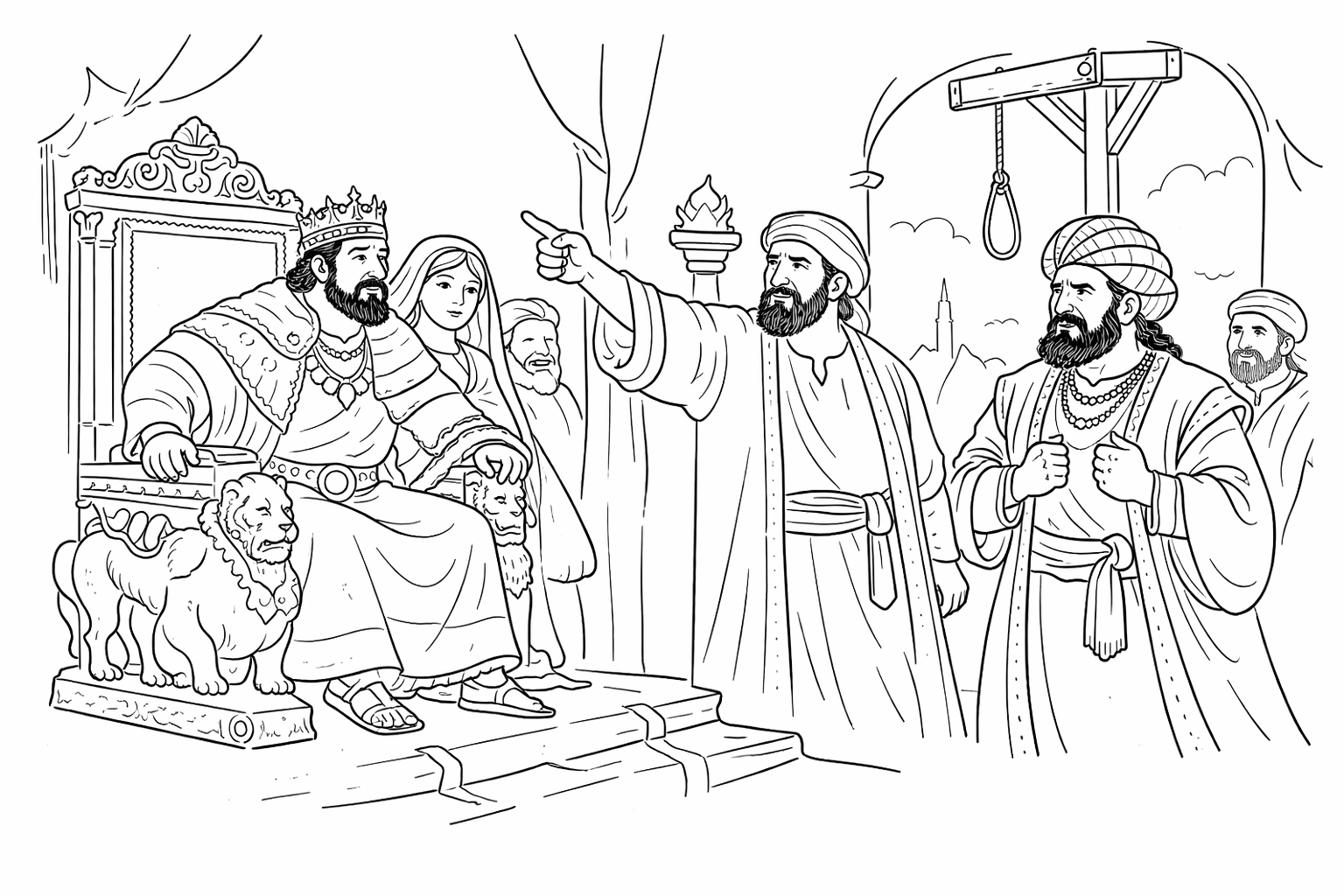
A long time ago, in the story of the Book of Esther, there was a king named Ahasuerus. He lived in a big, beautiful palace. In his kingdom lived Queen Esther and her cousin Mordechai.
There was also a mean man named Haman. Haman wanted everyone to bow down to him. But Mordechai would not bow. He knew that we only bow to the Creator. This made Haman very angry.
Haman made a terrible plan. He wanted to hurt the Jewish people. He even built a very tall gallows to hang Mordechai!
One day, the king began to understand that something very wrong was happening. He was angry, but he did not know exactly what to do.
Then something important happened.
One of the king’s servants, Harbonah, spoke up. He said,
“There is a very tall gallows standing outside. Haman built it for Mordechai—the man who once saved the king’s life.”
That one sentence changed everything.
Right away, the king understood. He said,
“Hang Haman on it!”
And just like that, the bad plan was stopped. Mordechai was saved. The Jewish people were saved. Everything turned around!
What can we learn from this story?
Sometimes one good and truthful word can change everything.
Harbonah was not a king. He was not a soldier. He simply spoke the truth—and that was enough to help good win.
After this miracle, many people saw how special it was. They saw that the Creator protects those who do what is right. Many people wanted to follow the Creator’s ways and live good, honest lives.
The story of Purim teaches us:
- Tell the truth, even if it feels scary.
- Stand up for what is right.
- Protect life and be kind to others.
You may feel small sometimes.
But your words are powerful.
One good word can help make the world a better place.
Par le rabbin Moshe Bernstein et Angelique Sijbolts
Source: Esther 7:9. Esther Rabbah 10:9. Megillah 16a. Mishneh Torah, Laws of Kings 9:14.
Si vous voulez d'autres questions à méditer, VOIR LES AUTRES BLOGS DU RABBIN MOSHE BERNSTEIN
© Copyright, tous droits réservés. Si vous avez apprécié cet article, nous vous encourageons à le diffuser.
Nos blogs peuvent contenir du texte, des citations, des références ou des liens qui comprennent des éléments protégés par le droit d'auteur de Mechon-Mamre.org, Aish.com, Sefaria.org, Chabad.orget/ou AskNoah.orgque nous utilisons conformément à leurs politiques.
 French
  English
  Dutch
Dutch  Spanish
  Italian
  German
  Hebrew
  Korean