
בס”ד
For Purim, we read the Megillah. This story happened a long time ago in the land of Persia. There was a king named Ahasuerus. He loved big parties. One day, he gave a huge feast with lots of food and drinks. Everything looked very beautiful.
It seemed like a wonderful party.
But something went wrong.
King Ahasuerus drank too much wine. He stopped thinking clearly. He wanted to show how important he was. He called Queen Vashti so everyone could look at her. That was not kind. That is not how you should treat a person.
This teaches us something important.
If someone only does what they want and does not think about others, things go wrong. Then we forget that every person is special.
G-d made every person important. No one should be used like an object or a toy.
The Sages teach us that eating and drinking are not bad. Celebrating is good! But we must do it in the right way. We should think carefully, be kind, and treat others well.
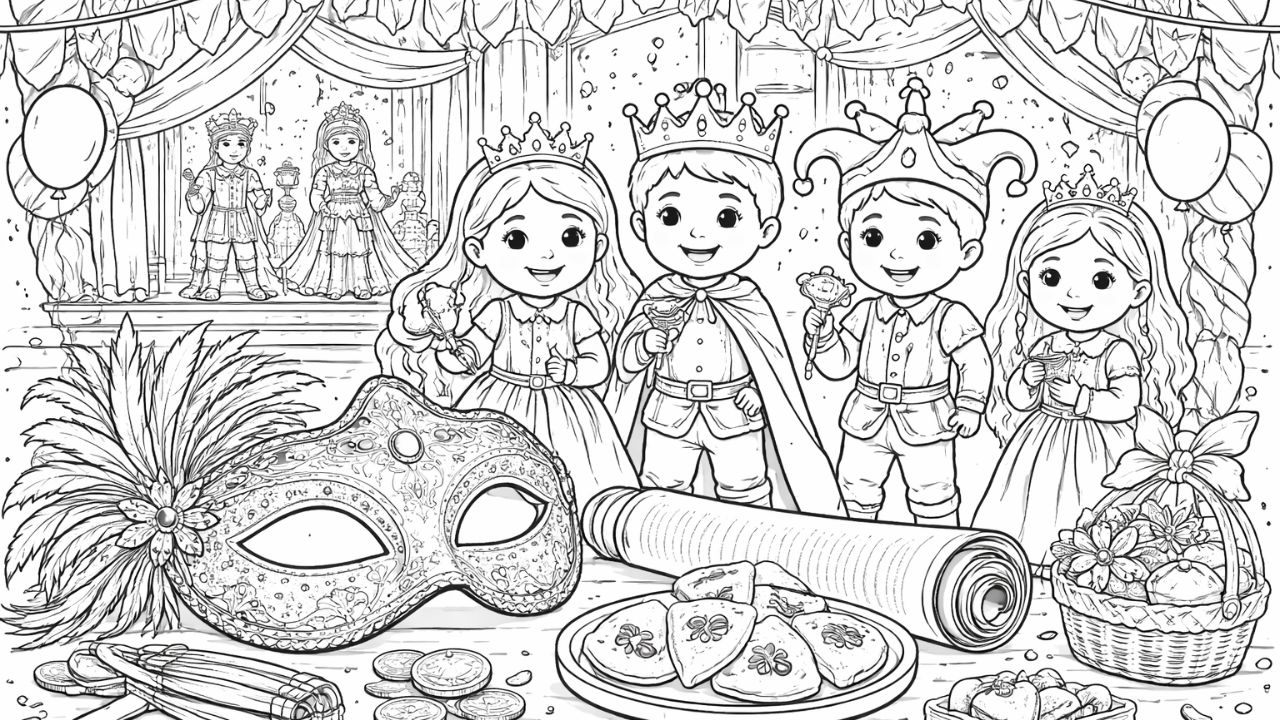
At the Purim holiday, people wear masks and costumes. A mask shows that you cannot always see what is really happening. Something might look nice on the outside but not be good on the inside.
Purim also teaches us:
- We can be happy.
- We can celebrate.
- But we must always try to do the right thing.
G-d also gave rules to everyone in the world, not just the Jewish people. These are called the Seven Noahide Laws. They teach people not to steal, not to hurt others, to be fair, and to make rules that help the world be good and safe.
When people follow these rules, the world becomes a better and safer place.
The loudest or strongest is not the real winner.
The real winner is the person who keeps choosing what is right.
That is what is behind the mask.
By Rabbi Moshe Bernstein and Angelique Sijbolts
Source: Tractate Megillah 12b. Torah Or Tetzaveh 83:4.
If you want more questions for contemplation, SEE THE OTHER BLOGS FROM RABBI MOSHE BERNSTEIN
© Copyright, all rights reserved. If you enjoyed this article, we encourage you to distribute it further.
Our blogs may contain text/quotes/references/links that include copyright material of Mechon-Mamre.org, Aish.com, Sefaria.org, Chabad.org, and/or AskNoah.org, which we use in accordance with their policies.
 English
  Dutch
Dutch  French
  Spanish
  Italian
  German
  Hebrew
  Korean