
בס"ד
Sam was six years old.
One day, his mother told him about Yom Kippur.
“Yom Kippur is a special day,” she said.
“It is a day to think about what we did.”
Sam asked, “What if I did something wrong?”
“Then you can say sorry,” Mom said.
“You can try to fix it.”
“And you can try to do better next time.”
“This is called teshuvah. It means coming back to G-d and choosing to do what is right.”
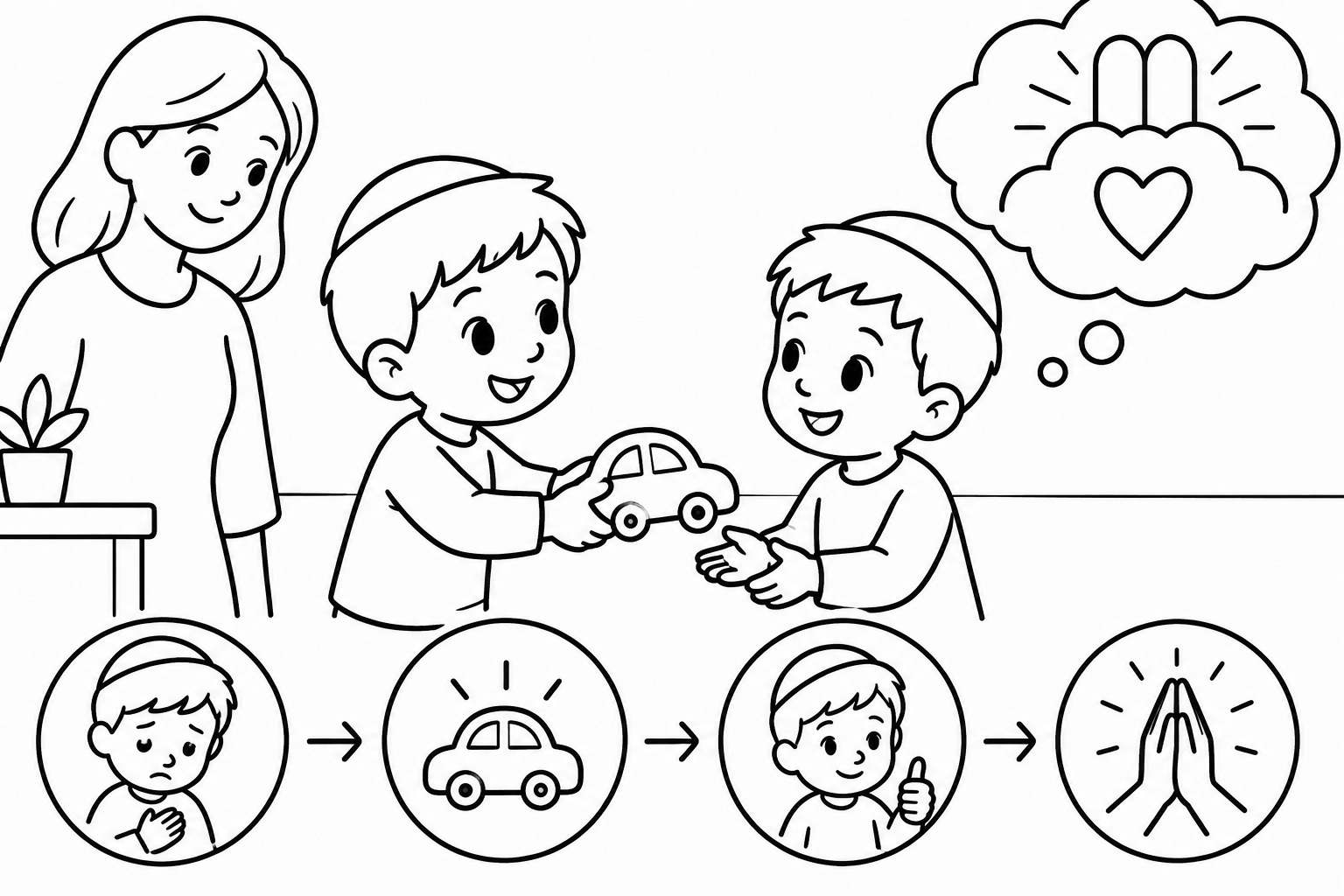
That day, Sam took his friend’s toy without asking.
His friend was sad.
Sam thought about what he had done.
“I am sorry,” he said.
He gave the toy back.
“Next time, I will ask first.”
Sam felt happy.
He had learned something important.
G-d wants us to do good.
We can pray to Him.
We can be honest.
We can help others.
And when we make a mistake, we can always try again.
Lesson:
Teshuvah means:
Say sorry.
Make it right.
Try to do better.
Come closer to G-d.
Door Rabbi Moshe Bernstein en Angelique Sijbolts
Bronnen:
The Book of Jonah: A clear biblical example of the repentance of the people of Nineveh (who were Noahides) and the Creator’s willing acceptance of their repentance.
Maimonides, Laws of Repentance 3:4: The universal dimension of Rosh Hashanah and the Ten Days of Repentance, in which the deeds of the inhabitants of the world are considered and the world is viewed as standing in a balance between merit and guilt.
Isaiah 55:6: “Seek the L-rd when He may be found, call upon Him when He is near”—which our Sages explain refers to the ten days between Rosh Hashanah and Yom Kippur.
Tanya, Iggeret HaTeshuvah, Chapter 2: Explanation of the inner essence of repentance that reconnects the soul to its root.
Als je meer vragen wilt om over na te denken, BEKIJK DE ANDERE BLOGS VAN RABBI MOSHE BERNSTEIN
© Copyright, alle rechten voorbehouden. Als je dit artikel leuk vond, moedigen we je aan om het verder te verspreiden.
Onze blogs kunnen tekst/quotes/verwijzingen/links bevatten die auteursrechtelijk beschermd materiaal bevatten van Mechon-Mamre.org, Aish.nl, Sefaria.org, Chabad.orgen/of VraagNoah.orgdie we gebruiken in overeenstemming met hun beleid.
 Dutch
Dutch  English
  French
  Spanish
  Italian
  German
  Hebrew
  Korean