בס "ד
It is Rosh Hashanah.
Rosh Hashanah means “Head of the Year.”
It is a very special day.
On this day, we think about G-d.
G-d made the whole world.
He gives us life every day.
On Rosh Hashanah, we say in our hearts:
“G-d, You are our King.”
We want to serve G-d.
We also want to become better people.
On this day, G-d looks at all people.
He sees the good things we do.
He also sees where we can do better.
This may sound a little scary.
But we can also be happy.
We trust G-d.
We hope for a good and sweet year.
That is why Jewish people eat sweet foods.
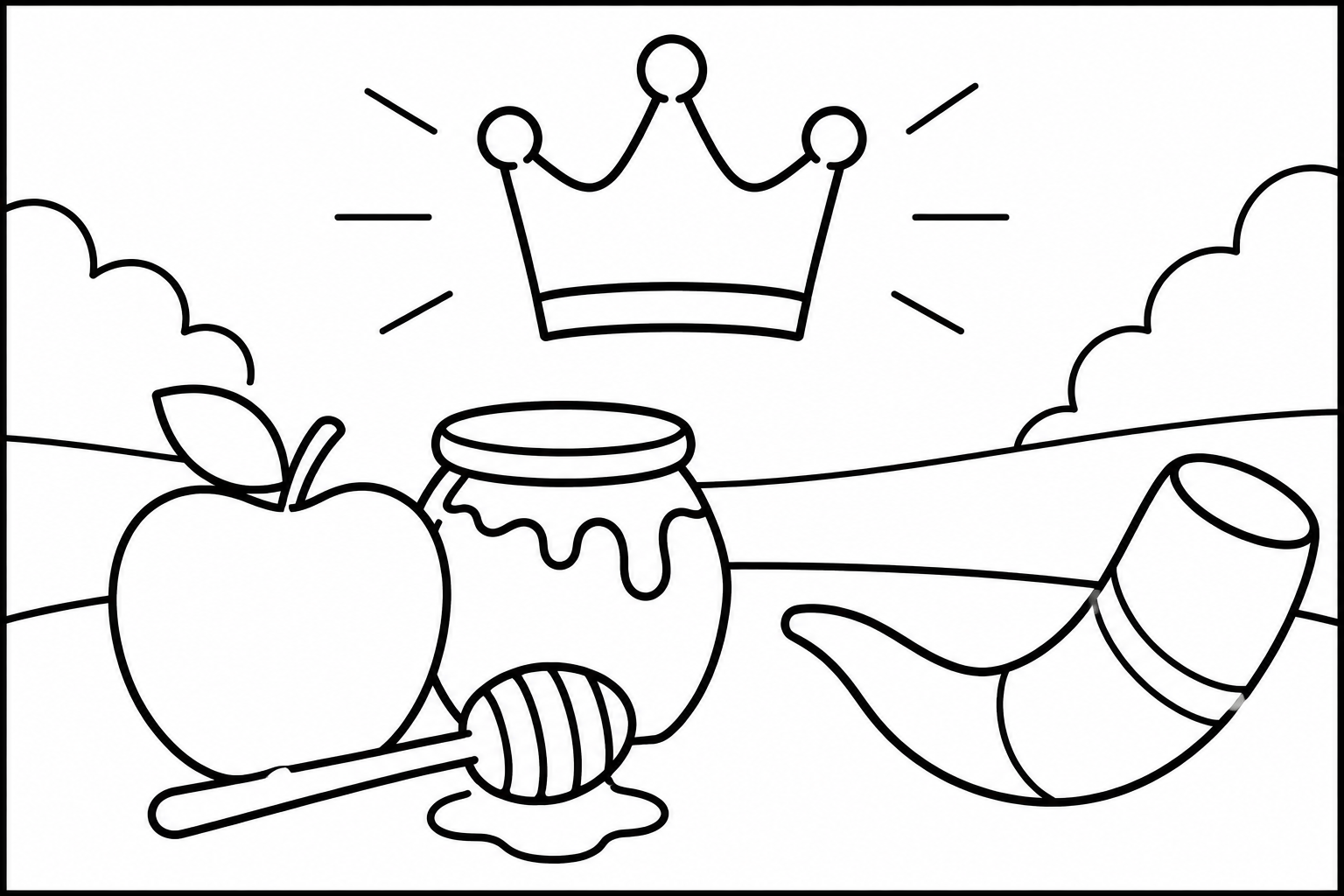
For example, they eat an apple with honey.
The honey is sweet.
It is a sign that we hope for a sweet and good year.
A Practical Example
Imagine that you are starting a new school year.
You think:
“This year, I want to be kinder.”
“I want to listen better.”
“I want to help my friends.”
“I want to do more good things.”
You can make a good promise.
You can say:
“Every day, I will try to do one good thing.”
That is something we can do on Rosh Hashanah too.
We think about our actions.
We choose good things.
We want to come closer to G-d.
We also pray for other people.
We ask G-d for peace.
We ask G-d for health.
We ask G-d to bless the whole world.
Rosh Hashanah is a day of respect.
But it is also a day of joy.
We are happy because G-d is our King.
And we are happy that we can serve Him.
A Lesson Is
G-d is our King.
We can always make a new start.
Choose to do something good every day.
And trust G-d with a happy heart.
Von Rabbi Moshe Bernstein und Angelique Sijbolts
Quellen:
Leviticus 23:24. Mishnah, Tractate Rosh Hashanah 1:2. Tanya, Igeret Hakodesh, Chapter 14. Babylonian Talmud, Tractate Horiyot 12a. Nehemiah 8:10. Babylonian Talmud, Rosh Hashanah 16a–16b. Keritot 6a.
Wenn Sie weitere Fragen zum Nachdenken haben möchten, SIEHE DIE ANDEREN BLOGS VON RABBI MOSHE BERNSTEIN
© Copyright, alle Rechte vorbehalten. Wenn Ihnen dieser Artikel gefallen hat, ermutigen wir Sie, ihn weiter zu verbreiten.
Unsere Blogs können Texte/Zitate/Referenzen/Links enthalten, die urheberrechtlich geschütztes Material von Mechon-Mamre.org, Aish.com, Sefaria.org, Chabad.orgund/oder FragNoah.orgdie wir in Übereinstimmung mit ihren Richtlinien verwenden.
 German
  English
  Dutch
Dutch  French
  Spanish
  Italian
  Hebrew
  Korean